Working with cards in Otper
Cards are the working records inside Otper. A good card tells the team what needs to happen, who owns it, when it is due, what decisions were made, and how the work changed over time.
Step-by-step
-
1. Create one card for one unit of work
Add a card from any list and give it a specific title. Keep the scope narrow: one task, request, bug, decision, or deliverable per card. This keeps ownership, due dates, and reporting meaningful.
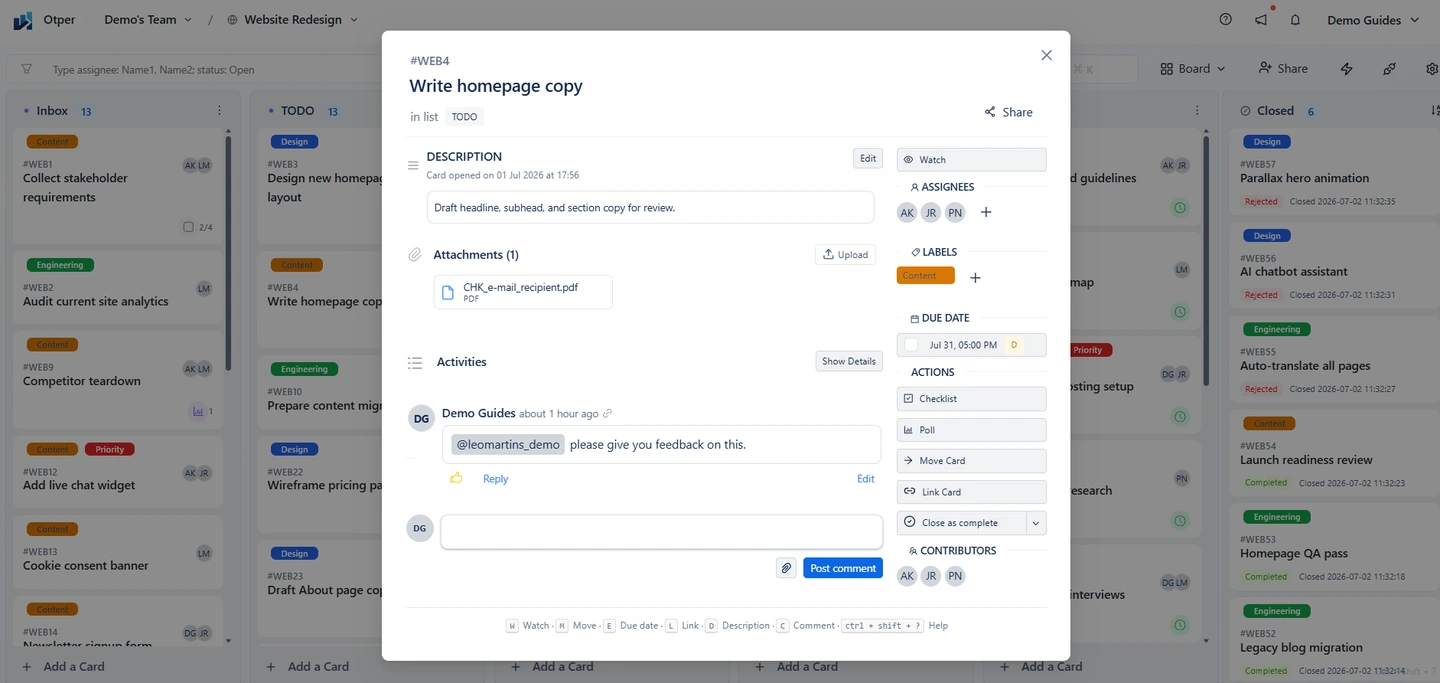
A card brings ownership, dates, checklist items, files, comments, and activity into one record. -
2. Assign owners, dates, and labels
Unowned work is the most common reason a card stalls: nobody is late, because nobody was responsible. Assign members as soon as the card exists so every item in the queue has a name against it. Set start and due dates where there is a real commitment, and apply labels consistently - priority, workstream, customer, type, risk, or any other signal your team filters and reports on.
Create the card, then assign it. Ownership set at creation is what makes the board readable later. -
3. Break down the work
Use the description for context and checklists for the steps that must be completed before the card is done. For structured board-specific information, use custom fields so the data stays consistent across cards.
Some checklist items turn out to be real work in their own right - they need an owner, a deadline, or a discussion of their own. Instead of losing that in a tick box, promote the item to a card. Otper creates the new card in the list you choose, links it back to the original card, and removes the item from the checklist, so the work moves into the queue without breaking the trail back to where it came from.
A checklist item that needs its own owner or deadline becomes a card, linked back to the card it came from. -
4. Keep collaboration on the card
Use comments, replies, mentions, attachments, and polls to keep decisions close to the work. Mention a teammate with
@name, attach supporting files, or create a poll when a card needs a quick team decision. The mobile app is useful when files or photos need to be added away from a desk. -
5. Move, watch, close, or reopen cards as work changes
Move cards across lists as their status changes. Watch important cards to keep them easy to revisit, close cards when the work is no longer active, and reopen them when follow-up work belongs in the same record.
How a card ends matters as much as whether it ended. Closing as complete and closing as rejected both take the card out of the active queue, but they record different outcomes: work that shipped versus work the team decided not to do. Keeping those apart is what stops declined requests from inflating your delivery numbers, and it gives you an honest record when someone asks months later why a request went nowhere. A closed card becomes read-only until it is reopened, so the outcome cannot be quietly edited after the fact.
Close as complete or close as rejected. The distinction keeps throughput reporting honest and the decision auditable.
Card hygiene checklist
- Title describes one unit of work
- Responsible members are assigned
- Due date is set where there is a commitment
- Labels match the board's naming conventions
- Checklist covers the visible definition of done
- Key decisions are captured in comments or polls
- Files and links are attached directly to the card
- Checklist items that need their own owner or deadline are promoted to cards
- Finished work is closed as complete, declined work as rejected
FAQ
Can a card have more than one member?
Yes. Add everyone doing the work, but keep one person clearly responsible for moving the card forward.
What is the difference between a checklist and a card?
Use a checklist for steps inside one deliverable. Create separate cards when each item has different owners, deadlines, files, or discussion. If an item already on a checklist turns out to need that, promote it to a card: the new card is created in the list you pick and linked back to the original, and the checklist item is removed.
What is the difference between closing a card as complete and as rejected?
Both remove the card from active work. Complete records that the work was delivered; rejected records that the team decided not to do it. Keeping them separate means declined requests do not count towards delivery, and you can filter for either outcome when reviewing a board.
Can a closed card still be edited?
No. A closed card is read-only, which keeps the recorded outcome trustworthy. Reopen it if follow-up work belongs in the same record.
What happens when a card moves?
The card changes status by moving to another list, and the activity history keeps a record of what changed.
Troubleshooting
| Problem | Fix |
|---|---|
| A mention did not notify anyone | Confirm the person has access to the board and has notification preferences enabled for mentions. |
| An attachment will not upload | Check the file size, network connection, and device file or photo permissions. |
| A card cannot be moved | Check whether the card or board is closed, and confirm your board role allows edits. |
Related guides
- How to set up a Kanban board
- Project management with Otper
- Using the Slack integration
- Using the mobile app
Ready to track your work as cards?