How to scale marketing project management with kanban
By Sambhav Aggarwal · Founder & Project Strategist at Otper. Expert in lean operational workflows and team accountability.
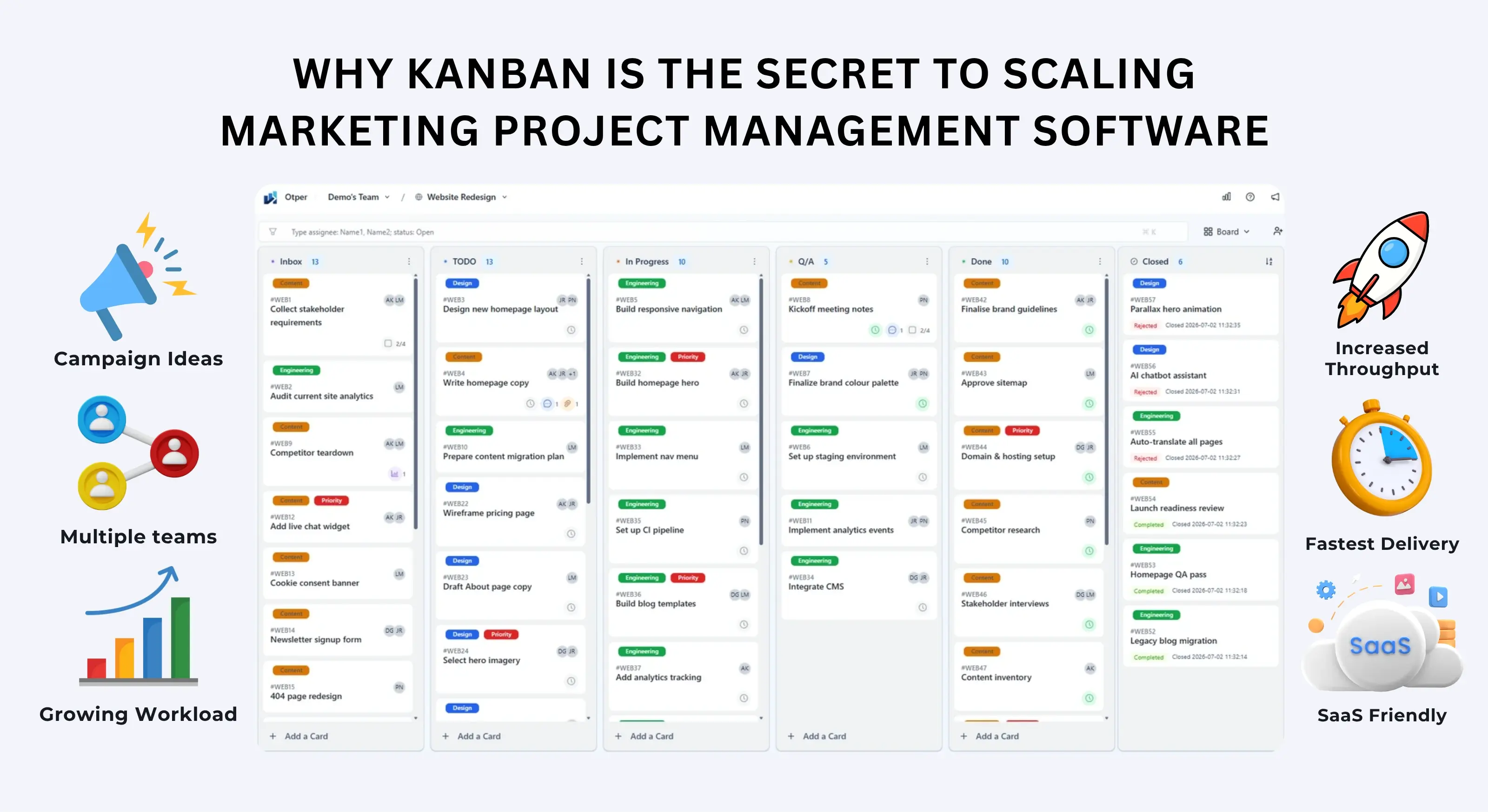
Marketing teams don't have a tool problem - they have a flow problem. This guide shows how Kanban for marketing teams fixes that flow: request intake that stops "who owns this?", WIP limits that prevent creative burnout, and delivery reporting your leadership actually trusts.
TL;DR
Marketing teams lose 28% of their week to operational drag (McKinsey). Scaling your marketing project management software isn't about adding features - it's about fixing flow. Kanban solves this with strict task ownership, workload balance to prevent burnout, throughput charts that show real delivery speed, and bottleneck detection that keeps creative pipelines moving.
Key takeaways
- Attributable task ownership, recorded on the card, closes the "I thought someone else owned it" gap.
- Measuring who is carrying what exposes capacity issues before burnout does.
- Throughput charts turn delivery conversations into data instead of hope.
- Bottleneck detection shows you where work is stuck, not just that it's late.
As your team grows from five to fifteen to fifty, the same marketing project management software that once felt liberating starts to feel heavy. Campaigns stall in review. No one knows who owns the next asset. Status meetings multiply. What worked for a small team creates operational drag at scale.
This post covers the scaling problem and the method behind it. If you want the product view instead - how intake, review queues and launch dates sit on one board - see kanban for marketing teams.
According to McKinsey's research on interaction workers, employees spend 28% of their work week managing email and another 19% searching for and gathering information. For remote marketing teams, that 47% tax is paid daily in the gap between "assigned" and "owned." In 2026, scaling marketing operations isn't about finding a more colorful board. It's about choosing a marketing project management software that enforces delivery, not just activity.
This is where Kanban project management stops being a methodology and becomes your scaling engine. It is not just a board. It is a delivery method built for high-velocity marketing teams.
What is Kanban project management for marketing teams?
At its simplest, Kanban visualizes work. But for marketing teams handling high-frequency content cycles, campaign launches, and cross-channel execution, Kanban project management is the operating system for operational planning.
Unlike list-based or spreadsheet-style PM tools that hide work in collapsed folders, a Kanban system makes flow visible. Every campaign, asset, and request moves through explicit stages - from ideation to brief, production, review, and delivery. This visual project tracker gives your entire team a single source of truth.
For marketing, traditional project management fails because it treats work as discrete tasks. Marketing work is flow. An eBook doesn't just get "done" - it moves through writing, design, legal, and distribution. Each handoff is a potential point of failure without clear operational visibility.
A true Kanban approach for marketing includes three non-negotiable principles:
1. Visualize every stage of work
If you can't see it, you can't improve it. A specialized marketing project management software built on Kanban exposes your entire operational planning process. Instead of separate tools for editorial calendars, design requests, and campaign launches, your project timeline lives in one place. Designers, copywriters, and media buyers all see the same flow. This eliminates the fragmented context that causes operational drag.
2. Limit work in progress
Marketing teams are notorious for starting more than they finish. Kanban replaces the "do everything now" mentality with disciplined flow - and that starts with being able to see how much is genuinely in progress, and who is carrying it.
3. Maximize flow, not utilization
The goal isn't to keep everyone 100% busy. The goal is to get campaigns shipped predictably. Kanban optimizes for flow - how quickly a card moves from "To Do" to "Done" - rather than vanity metrics of tasks assigned.
In our comparison of the best marketing PM software for 2026, we saw that general-purpose tools like Monday.com and ClickUp offer endless customization. They let you build any workflow. But at scale, customization becomes bloat. Marketing teams don't need another platform to configure. They need a marketing project management software that makes the right way the easy way: owned tasks, measured flow, and automated upkeep.
That is the difference between a digital whiteboard and a delivery engine.
The ownership gap: why marketing teams stall without team accountability
Every delayed campaign has the same post-mortem: "I thought someone else owned it."
This is the ownership gap - the space between a task being assigned and being truly owned. In most marketing project management software, a task can be assigned to multiple people, assigned to no one, or assigned and then forgotten. The result is the bystander effect at organizational scale. Work becomes orphaned, status is ambiguous, and managers spend their days chasing updates instead of leading.
The cost is operational drag. When team accountability is optional, delivery reporting becomes manual. Your standup becomes an interrogation: "Who's working on the nurture sequence? Where is the webinar deck?" Your project status reports are outdated before they're sent because they're built from voluntary updates.
High-accountability teams solve this differently. They use a marketing project management software where ownership is attributable on the card itself, and where work nobody has claimed is easy to find rather than easy to miss.
Otper's approach to task ownership is minimalist but pointed: owners live on the card - one person or several - and every assignment and handoff is recorded, so a card that changed hands three weeks ago is still answerable today. When a card is stalled, you don't ask the team, you ask the owner. And work that nobody has claimed does not hide: group a board by member and unowned cards collect in their own band, or have a list post a daily reminder on every card in it that still has no owner.
This is more than a feature. It's a cultural contract built into your PM tool. Compare this to all-in-one platforms where accountability is a custom field you have to remember to configure. In Monday.com or ClickUp, you can build an ownership system if you have the time and discipline to maintain it. In a Kanban-native marketing project management software designed for delivery, ownership is the default.
For operational planning at scale, this distinction is critical. You cannot scale trust without traceability. Task ownership creates traceability. When every asset has a name attached, your team moves from collective responsibility (which often means no responsibility) to individual commitment with team support. This is how you eliminate operational drag without adding process overhead.
Scaling isn't about hiring more managers to track work. It's about building a system where work tracks itself because ownership is explicit.
Measuring work in progress prevents marketing burnout
Marketing burnout doesn't come from hard work. It comes from too much work in progress.
The modern marketing team is asked to run five campaigns, produce fifteen assets, and manage three channels simultaneously. Without guardrails, your marketing project management software becomes a graveyard of half-finished work. Designers context-switch between six requests. Copywriters have twelve drafts in "In Progress." Nothing ships, but everyone feels overwhelmed.
The Kanban answer is to treat work in progress as a number you watch rather than a feeling you have. Otper reports how much is open right now, how much each person is carrying as a share of the team average, and how long cards are actually sitting in each stage - so "we have too much in flight" is a figure on screen instead of an argument.
The effect is immediate and profound:
1. It forces finishing over starting
Marketers are natural starters. Seeing completed-versus-created side by side each week rewards finishing: when the created line outruns the completed line, starting more is visibly the wrong move. Your project tracker stops being a to-do list and becomes a throughput engine.
2. It makes context switching visible
Research consistently shows context switching can cost up to 23 minutes per interruption. When the workload report shows a designer holding eight active cards while the team average is three, the juggling stops being invisible - and it becomes a reprioritisation you can actually make.
3. It exposes capacity issues early
Without measurement, overload is invisible until burnout or missed deadlines reveal it. With it, overload shows up as a number: one person at 31% of the team's active work against a 20% average, or a stage whose cards are sitting three times longer than any other. That gives managers a chance to reprioritise or redistribute before the team breaks.
Most marketing project management software treats this kind of analysis as an advanced dashboard you have to configure. In Otper it is derived from the board automatically: open a report, pick a date range, and the workload split and per-stage queue times are already there for every board you can see.
For scaling teams, this is the difference between sustainable growth and heroic collapse. You can add headcount, but without flow discipline you will just add more work in progress. Watching throughput against workload tells you whether a bigger team is actually shipping more, or just holding more.
This minimalist constraint is what allows high-accountability teams to ship faster with less stress. It's not about doing more. It's about finishing what you start.
Throughput charts & project status reports: automating the truth
If team accountability answers "who owns it," throughput and reporting answer "are we keeping up?"
At scale, manual project status reports are operational drag in its purest form. A marketing manager spends 4–6 hours per week assembling slide decks, copying data from their marketing project management software into spreadsheets, and reconciling conflicting updates from three different PM tool instances. By the time the report is delivered to leadership, it's already stale.
Worse, these reports measure activity, not delivery. They show tasks created versus tasks completed, but they don't predict whether the Q3 campaign will actually launch on September 15th.
This is the problem throughput charts and automated delivery reporting solve.
A throughput chart tracks how many cards your team creates against how many it completes in a given period - per day, week or month. Over time that becomes a historical baseline of your team's actual shipping speed, alongside the median number of days a card takes to finish. Unlike estimates, both are measured from finished work. They don't flatter anyone.
A Kanban-based marketing project management software with proper throughput tracking can:
- Ground planning in measured pace: If your team consistently completes 22 cards a week and a launch needs 88, a four-week window is a conversation about evidence rather than optimism. You still make the call - the numbers stop you making it blind.
- Take the data-gathering out of status meetings: When reporting is derived and real-time, stakeholders can check it themselves. The report shows what's shipped, what's overdue, what's stalled, and who owns the next move, without anyone "updating the doc."
- Identify trends before they become problems: A throughput chart that drops from 25 to 12 completed cards a week is an early warning. Read alongside the workload split and the per-stage queue times, it tells you whether the slowdown is overload, a bottleneck, or scope creep - long before a deadline is missed.
General-purpose tools treat reporting as an add-on dashboard you configure after the fact. Monday.com and ClickUp offer highly customizable widgets, but they still require manual setup and consistent data hygiene to be accurate. A specialized marketing project management software built for delivery bakes reporting into the flow itself. Every card movement feeds the throughput chart. Every owner's progress is reflected in the timeline and the workload split in real time.
The result is project status reports that write themselves. Your team doesn't report on work. Your board reports the work. This reclaims the 28% of the week previously lost to status gathering and returns it to creative and strategic work - the work that actually grows the business.
Automated truth scales. Manual reporting doesn't.
Bottleneck detection in creative pipelines
Every marketing pipeline has a bottleneck. The question is whether your marketing project management software helps you find it before it costs you a launch.
In a typical campaign flow - Brief → Copy → Design → Review → Development → QA → Launch - work rarely flows evenly. Copy might wait three days for legal review. Design might pile up while assets sit in "Pending Feedback." Without visibility, these queues are invisible. Work appears "in progress" when it's actually stuck.
Bottleneck detection is Kanban's diagnostic power. Because Kanban visualises flow and measures how long work waits, it makes stagnation impossible to hide:
1. Stages are scored on how long work waits
Otper measures the average number of days cards actually spend in each list, ranks the stages against each other, and marks them healthy, warning or critical. You don't have to work out for yourself that "Review" is the problem - it is at the top of the chart, in red, with the number attached.
2. Aging charts reveal hidden queues
A card that should take 2 days but has spent 8 in one column is a bottleneck signal. Otper ages each card and flags anything with no activity for seven days or more as stuck, with its owner and its list. This is operational visibility that a simple list view cannot provide.
3. It shifts conversation from blame to flow
Instead of asking "why is Sarah slow?," Kanban asks "why is the Review column overloaded?" This depersonalizes the problem and focuses the team on systemic fixes - perhaps review capacity needs to be increased, or requirements need to be clearer before entering review.
For creative pipelines, this is transformative. Marketing work is iterative and approval-heavy. Without bottleneck detection, your team repeats the same delay every campaign: waiting on the CMO, waiting on legal, waiting on brand. With it, you can apply targeted solutions:
- If "Design Review" is the bottleneck, set an automation that comments on, labels or escalates a card three days before its due date, so owners hear about it before it slips.
- If "Copywriting" is overloaded, redistribute using the workload split against the team average.
- If "Development" is stalled, clarify ownership and handoff criteria.
Most marketing project management software shows you that work is late. Kanban shows you why it's late and where it's stuck. This distinction is what allows marketing teams to move from reactive firefighting to proactive operational planning.
At scale, bottleneck detection is your compounding advantage. Fixing one bottleneck improves the throughput of the entire system. Each improvement lifts the completed line on your throughput chart, which in turn makes your planning more reliable. This creates a flywheel: visibility → flow → predictability → trust.
That is how you scale delivery without scaling chaos.
How Otper combines Kanban + accountability
Monday.com sells flexibility. ClickUp sells everything. Otper sells delivery.
The specialized approach matters when you scale. While all-in-one platforms require you to build and maintain your ideal workflow, Otper's marketing project management software is opinionated by design: minimalist Kanban, enforced ownership, and automated visibility. Monday.com's visual automations are powerful for custom workflows, and ClickUp's goal tracking is robust for diverse teams - but both require significant administration to achieve what Otper provides out of the box: a system where accountability drives flow.
Here is how Otper combines Kanban with accountability to scale marketing teams:
1. The visual source of truth
Your project timeline is not a separate Gantt chart to maintain. It is your Kanban board with time overlaid: a card with a start date and a due date is a bar, grouped by stage, owner or label, and undated work is listed rather than dropped. Designers, writers, and stakeholders see the same operational view. This eliminates fragmented context - the primary driver of McKinsey's 19% search-and-gathering tax.
Unlike general PM tools that keep board and plan in separate places, Otper has only one set of dates. Change a due date on the card and the bar moves. There is nothing to re-sync, which is exactly why the schedule cannot quietly go stale.
2. Owned tasks + workload balance + automations
This is the delivery trifecta.
- Owners live on the card, and orphaned work is surfaced by grouping or a daily unassigned-cards reminder rather than left to chance.
- Workload reporting shows each person's share of active work against the team average, so overload is caught as a number.
- Automations fire on real events - a due date approaching, a card landing in a list, every checkpoint ticked - to comment, label, assign, move or close the card before a delay cascades.
Together, these create a self-regulating system. Managers don't chase. The system signals.
3. Automated delivery reporting & throughput
Otper's delivery reporting suite removes manual work entirely:
- Throughput charts show created against completed per day, week or month - measured pace, not estimates.
- Project status reports are generated live - no deck building required. Stakeholders see shipped, stalled, overdue and at-risk work in real time.
- One view shows open work, per-stage queue times, and bottleneck health at a glance, across one board or all of them.
This is the same philosophy that powers our homepage promise: stop the operational drag. Standard marketing project management software adds features. Otper removes drag - the drag of unclear ownership, unmeasured overload, and outdated reporting.
4. Built for marketing, not for decorating
Otper is deliberately minimalist. We don't offer ten ways to view the same work. We offer the one way that ensures delivery. For teams that value speed and ownership over decorative boards, this focus is the scaling advantage. You spend time shipping campaigns, not configuring your marketing project management software.
This article builds on our comparison of marketing PM software: accountability + Kanban + visibility is what turns a board built for a five-person team into one that still works at fifty. If your current PM tool requires more process to manage the process, it's time to switch to a system that manages flow for you.
FAQ
Is Kanban good for marketing teams?
Yes - Kanban fits marketing because marketing work is flow work: briefs, assets, reviews, launches. A board with stages like Brief → In Production → Review → Scheduled makes every asset's owner and stage visible, WIP limits on each stage stop creatives drowning in parallel requests, and per-stage queue times show whether review is where the work is actually waiting.
How do marketing teams use kanban?
One board per team, not per project. Requests arrive in the board's first list - posted there by a request form or internal tool through the board's webhook URL, or created straight from Slack with /otper create-card - and move through production and review stages with an owner and due date on every card. A weekly bottleneck review covers much of what a status meeting was collecting, and throughput charts answer "how fast are we shipping?" with data.
How big is the kanban software market?
Definitions vary, so the numbers do too. 360MarketUpdates puts the narrower kanban project-management software segment at USD 262.49 million in 2026, growing to USD 367.18 million by 2035 (3.80% CAGR). Verified Market Reports sizes the broader kanban board software market at USD 1.5 billion in 2025, reaching USD 4.2 billion by 2034 (12.5% CAGR). Either way it's a growing category - which is exactly why differentiation matters.
What is Kanban project management and why is it ideal for marketing teams?
Kanban is a visual methodology that helps teams visualize work, limit WIP, and maximize flow. For marketing teams, this is ideal because campaigns are flow-based, not task-based. Otper enhances standard Kanban with team accountability and automated delivery reporting to eliminate operational drag and ensure every asset has a clear owner.
How does marketing project management software solve operational drag?
Operational drag is the 28% of time lost to unclear ownership and manual reporting (McKinsey). A specialized marketing project management software like Otper solves this by keeping ownership on the card, measuring workload and per-stage queue times so overload is visible early, and deriving delivery reporting from card activity so status is always real-time and traceable.
How does measuring work in progress prevent burnout?
Overload is usually invisible until someone breaks. Otper reports how much work is open, how long cards are sitting in each stage, and each person's share of active work against the team average - so overload shows up as a number early enough to reprioritise, rather than as burnout you discover afterwards.
Can throughput charts really help predict delivery?
They give you measured pace instead of guesswork. Otper charts cards created against cards completed per day, week or month, and reports the median days your team takes to finish a card. Plan against those numbers and a delivery window becomes evidence-based - and stakeholders can read it themselves, without a manual status report.
How is Otper different from Monday.com or ClickUp?
Monday.com and ClickUp are highly customizable all-in-one platforms that can become bloated and complex. Otper is a specialized Kanban workspace focused on delivery - combining minimalist boards with strict task ownership, bottleneck detection, and automated reporting for high-accountability teams that need to ship, not configure.
Scale flow, not just headcount
Scaling a marketing team doesn't fail because you hired too slowly. It fails because your flow didn't scale with your headcount.
Adding people to a chaotic marketing project management software just adds more chaos. Tasks multiply. Ownership diffuses. Reporting gets heavier. Burnout increases. The promise of growth turns into the reality of operational drag.
Kanban breaks this cycle. It replaces chaos with flow: visual work, named ownership, measured workload, measured throughput, and visible bottlenecks. It turns your marketing project management software from a task tracker into a delivery engine. It gives you the operational visibility to plan launches on evidence, the team accountability to ensure ownership, and the discipline to ship sustainably at scale.
This is why Kanban is the secret to scaling. Not because it's a prettier board, but because it's the only method that makes accountability, focus, and predictability non-negotiable.
Related reading
- Best marketing project management software for remote teams in 2026
- Workflow automation for Kanban teams
- Using Kanban analytics to find bottlenecks and overdue work
- Kanban board setup: a step-by-step guide
- Kanban for marketing teams: from request to shipped
Ready to eliminate operational drag and scale delivery?
Explore how Otper combines Kanban, workload balance, and automated delivery reporting in one minimalist workspace built for high-accountability teams.
Start for Free with Otper