ClickUp and Asana alternatives: what delivery teams should compare
ClickUp and Asana are broad work-management platforms, built to cover many kinds of team with a wide range of views and customisation. Teams who go looking for an alternative are usually not after more features. They want fewer steps between the work and a straight answer about it.
Compare the four answers, not the feature list
A delivery team needs four things from its tool. Judge any alternative on how much setup sits between you and each one, because that cost is paid again every time the team changes shape.
- What shipped - completed counts and throughput for the period.
- What is late - every overdue card, who is on it, and how many days it has been.
- What is blocked - cards with no activity for seven days or more, flagged as stuck.
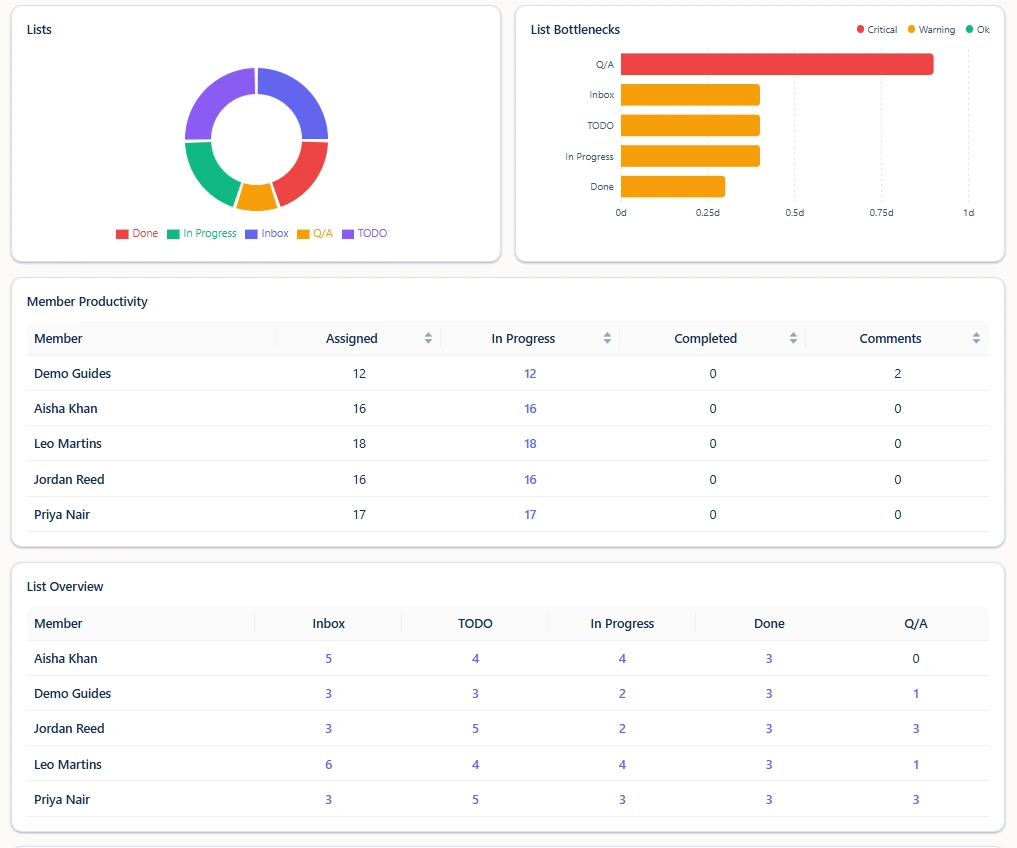
- Who is carrying too much - each person's share of active work against the team average.
In Otper all four are computed from board activity rather than configured, so overload is a number rather than a hunch and nobody has to assemble a dashboard first.
Limits that hold, not just labels
Most tools let you note that a stage is overloaded. Otper lets you stop it. Each list takes a soft limit that turns the stage amber as a warning, and a hard limit that blocks new cards from entering once it is full. The hard limit is enforced on the server, so a drag, a bulk move and an automation all respect it. For a delivery team, that is the difference between knowing a queue is building and preventing it.
Several projects, one view
Agencies and delivery teams rarely run one project. Scope a single report across every active board and the numbers cover the whole portfolio, including workload - which is how you catch one person quietly becoming the bottleneck on three projects while looking fine on each. Board comparison puts every project in one table on identical columns, so the outlier stands out instead of being remembered.
Where Otper is the better choice
Otper is the better choice when delivery is the whole job. The four answers are there on day one with no configuration step, because the reporting derives from board activity rather than fields someone has to keep current. WIP limits do not simply describe an overloaded stage, they stop it filling. Workload is measured across every active project at once, which is where the real risk in an agency actually sits. And the same cards render as Board, List, Gantt or Tickets, so nobody maintains a second system just to get a timeline.
The practical effect is less to learn, less to maintain, and less that quietly goes stale. A broader platform is the right shape if you need one system spanning sales, HR and marketing ops as well, and Otper has no task dependencies, milestones or resource planning. For a team whose job is shipping client work, that is a smaller surface and a faster answer.
FAQ
What should a delivery team compare when evaluating alternatives?
How much setup stands between you and four answers: what shipped, what is late, what is blocked, and who is overloaded. Feature counts rarely decide whether a tool improves delivery.
Does Otper report across several projects at once?
Yes. Scope one report across as many boards as you choose, or compare boards side by side on identical columns - total cards, created, in progress, completed, overdue, closed and active members.
Can I stop a stage from overfilling?
Yes. Each list takes a soft limit that warns and a hard limit that blocks new cards from entering. The hard limit is enforced on the server, so manual moves and automations both respect it.
Can I export delivery data for a client update?
Yes. Any report exports to CSV or PDF for the boards and date range you selected, so a client sees their engagement and nothing else.
Keep reading
- Jira vs. Otper for small engineering teams
- Managing multiple client projects
- What Otper reporting measures
See the four answers on your own work
Move one project across, set a limit on your review stage, and run a report at the end of the week.
Get started free